Strengthening Genomic Surveillance in West Africa
3 September 2025 London School of Hygiene & Tropical Medicine London School of Hygiene & Tropical Medicine https://lshtm.ac.uk/themes/custom/lshtm/images/lshtm-logo-black.png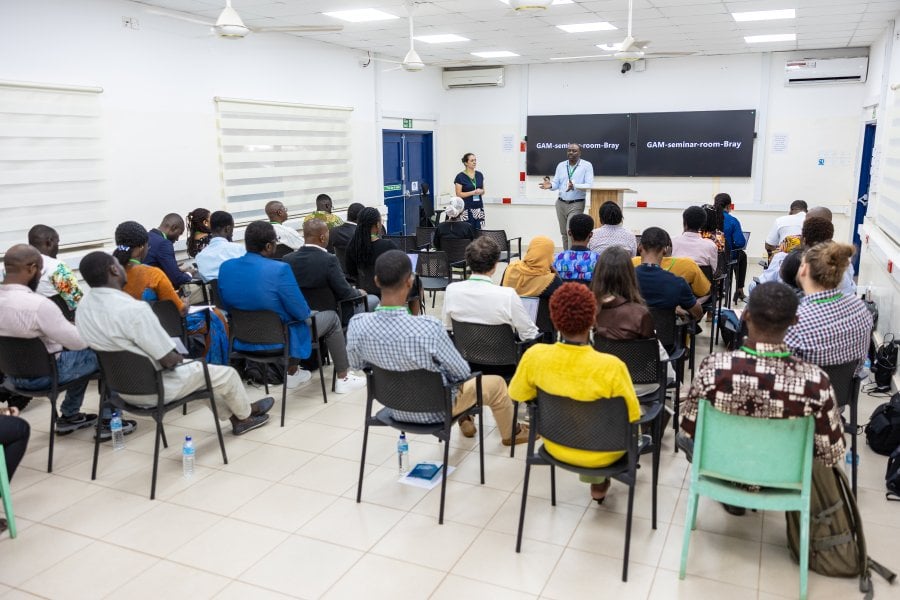
In collaboration with the Wellcome Sanger Institute, University of Ghana, Liverpool School of Medicine, West African Centre for Cell Biology of Infectious Pathogens (WACCBIP), Cambridge Africa and the Malaria Genomic Epidemiology Network, the project brought together 48 participants (researchers and National Malaria Program stakeholders from seven West African countries to strategise on technical and operational infrastructure needs for regional genomic surveillance of malaria parasites and their mosquito vectors.
With support from the National Institute for Health and Care Research (NIHR), this initiative aims to build local capacity for genomic surveillance of malaria parasites and vectors while generating analytical tools of direct value to National Malaria Control Programmes (NMCPs) in designing and implementing effective interventions against growing challenges such as drug and insecticide resistance.
By strengthening collaboration, data sharing, and research capacity, this project will play a critical role in shaping strategies to reduce the burden of malaria and strengthen epidemic preparedness across West Africa.
Dr. Vikki Simpson, Project Director at the Wellcome Sanger Institute, highlighted the importance of the next phase. “What excites me most about this meeting is that we are entering the next phase, transforming our proven ability to generate and use data into tangible public health impact. The groundwork has been laid; now we must work together to shape the next three to five years, ensuring that our progress translates into lasting, meaningful change.”
Professor Alfred Amambua-Ngwa, Principal Investigator of the Genomic Surveillance of Malaria project at MRCG at LSHTM, underscored the urgency of turning research into meaningful impact. “The vision entrusted to us must now be translated into reality. This means moving beyond laboratories to shape decisions in hospitals, strengthen public health systems, and support communities in managing vectors, treating patients, and protecting those at risk. Our responsibility goes beyond generating knowledge; it is to transform that knowledge into action that truly serves populations.”
Dr Eniyou Cheryll Oriero, a Researcher at LSHTM and the first Malaria Centre Co-Director based at the MRC Unit The Gambia, drives research activities for the GSM Project at the Gambia hub. “Transitioning from knowledge generation research to impact for public health requires that the National Public Health laboratory personnel are adequately trained and equipped to generate and interpret the data. Collaborations fostered by the GSM Project demonstrate a framework on how this can be achieved at both national and regional levels."
By the end of the project, the consortium is expected to deliver proof-of-concept data, validated protocols, and implementation systems that will allow molecular malaria surveillance (MMS) to be embedded into routine NMCP operations. The work also aims to provide a model for how such systems can be scaled and applied across borders in Africa to support regional malaria elimination strategies.
If you enjoyed this article and would like to build a career in global health, we offer a range of MSc programmes covering health and data, infectious and tropical diseases, population health, and public health and policy.
Available on campus or online, including flexible study that works around your work and home life, be part of a global community at the UK's no.1 public health university.