Spotlight: Mohamed Eissa
12 November 2025 London School of Hygiene & Tropical Medicine London School of Hygiene & Tropical Medicine https://lshtm.ac.uk/themes/custom/lshtm/images/lshtm-logo-black.png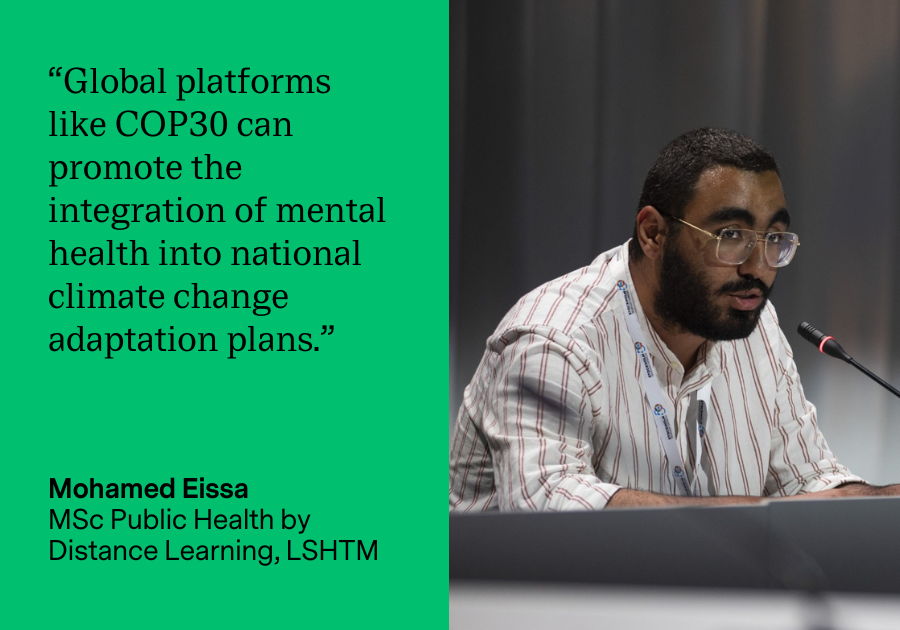
Mohamed Eissa is an MSc Public Health by Distance Learning student, and a former Student Liaison Officer for the Global Health Economics Centre (GHECO). Earlier this year, he led on a report entitled: Integrating Mental Health into Climate Change Adaptation Policies.
In this interview Mohamed shared some insights on the report, the importance of integrating mental health into climate adaptation policy and the role platforms like the United Nations Climate Change Conference (COP) can play in promoting the issue through initiatives like The Belém Health Action Plan.
Could you introduce yourself?
I am a medical doctor by training and currently pursuing a career in public health. I have recently acquired an MSc degree in Health Economics and I’m working as Public Health Officer within the Healthier Populations department at WHO Egypt.
You recently led work in publishing the report Integrating Mental Health into Climate Change Adaptation Policies. Could you tell us about your involvement in the report and describe its key findings and highlights?
I have been responsible for the review and quantitative and qualitative analysis of the climate change adaptation policies, regarding their integration of mental health, in addition to the drafting of the policy brief. The review included 193 countries and showed that 42% of countries mention mental health in their climate adaptation policies, 36% of countries mention climate change-related mental health impacts in their adaptation policies and 17% of countries include adaptation actions to address mental health in their adaptation policies.
What are the links between environmental change and mental health, and what more needs to be done to integrate mental health into climate adaptation?
Climate change negatively impacts mental health by increasing the risk of new mental health problems or exacerbating existing ones, in addition to worsening the social, economic, and environmental determinants of mental health. It also contributes to a range of psychological reactions that affect the overall health and wellbeing of individuals and population.
The policy brief calls for policy makers to recognise the negative impacts of climate change on mental health and the increased risks that certain groups with specific vulnerabilities may face. Another important action is monitoring the mental health impacts of climate change, as well as any mental health risks and co-benefits of adaptation at the national level to ensure appropriate and effective responses. A key recommendation from the brief is to ensure specific adaptation actions are planned and implemented to both protect and promote good mental health, and prevent and manage mental health problems.
Why is mental health such an important component of climate change policy, and why does it need more attention?
This is due to several factors such as the climate change impacts on mental health, how mental health is an integral component of resilience and adaptation, in addition to the unequal distribution of climate impacts and mental health burden, requiring a people-centred, justice-based approach.
There are a lot of missed opportunities of integrating mental health into national adaptation plans, especially in the context of limited funding, research and technical guidance on this critical interlinkage. Global platforms such as COP exist to bring together the climate and health agendas, in intersection with finance and implementation.
Such platforms can support the mobilisation of resources for psychosocial support and resilient health systems and the inclusion of mental health indicators and interventions into the countries’ climate change plans. This would be particularly relevant for COP30 this year. The Belém Health Action Plan, set to be launched on ‘Health Day’ (13 November), already includes a specific reference to integrating mental health into climate adaptation in the health sector.
What role can health economics play in integrating mental health into adaptation policy and supporting effective climate action more broadly?
Health economics can help us to measure economic losses affecting vulnerable groups due to the impact of climate change on their mental health and productivity. This allows us to also use health economics methods in identifying financing opportunities for integrating mental health into climate change adaptation plans.
Outside of the report, what are you currently studying and working on?
At the moment, I am studying an MSc Public Health (by Distance Learning) at LSHTM. I’m balancing this alongside working within the WHO Egypt Country Office on Environment, Climate Change and Health, Sexual, Reproductive and Maternal Health, Newborn and Child Health, and Ageing.
My time as a Distance Learning student allows me to effectively combine my studies and work. It’s been great to see how the studies’ content can be applied in real life practice and how the real work aligns with what I am studying. It’s really allowed me to work in a more effective, evidence-based manner.
If you enjoyed this article and would like to build a career in global health, we offer a range of MSc programmes covering health and data, infectious and tropical diseases, population health, and public health and policy.
Available on campus or online, including flexible study that works around your work and home life, be part of a global community at the UK's no.1 public health university.