Heatwaves, floods, and vaccines: How climate change is shaping the future of immunisation
20 October 2025 London School of Hygiene & Tropical Medicine London School of Hygiene & Tropical Medicine https://lshtm.ac.uk/themes/custom/lshtm/images/lshtm-logo-black.png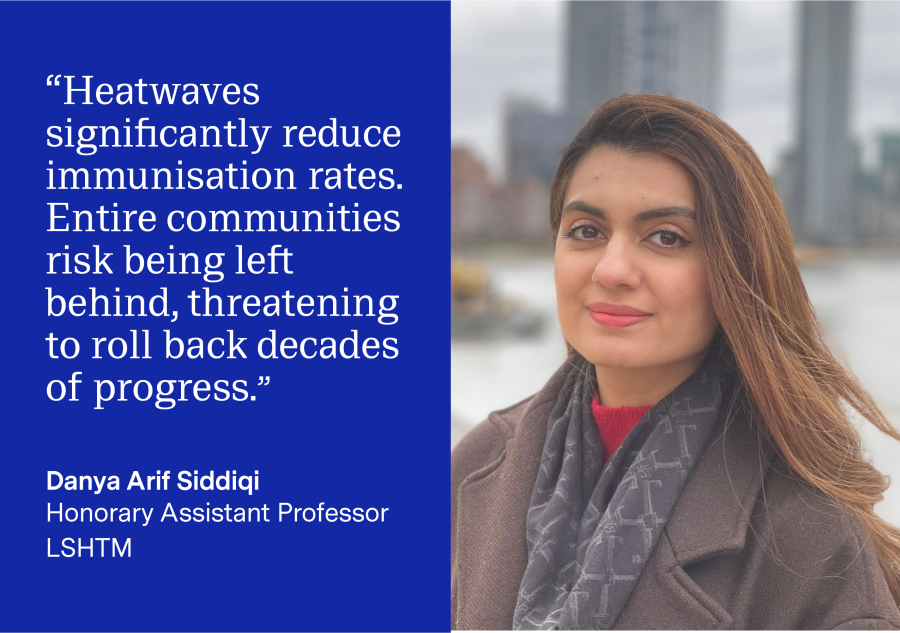
Each summer I visit Pakistan for work and to visit my family. With every passing year, I’ve noticed how the heat feels harsher, heavier, and more relentless, with temperatures now regularly touching 45°C. This discomfort is just a mere glimpse of the harsh reality for millions of families across South Asia, whose daily life, livelihoods, and health are impacted by extreme temperatures.
Extreme heat is just one face of climate change alongside other manifestations such as floods, droughts, and wildfires. Among the various pathways through which climate change is impacting health, one of the most worrying is the fuelling of infectious diseases. A study in Nature reported that 58% of all infectious diseases that have impacted humanity historically were aggravated by climatic hazards. Bangladesh, for example, is currently grappling with a dual outbreak of dengue and chikungunya, and in the recent WHO global cholera statistics, cases have risen by 5% and deaths by 50% in 2024 compared to 2023.
What is especially concerning is that climate change is not only causing new outbreaks but also undermining our ability to protect against existing ones. Floods, drought and extreme temperatures damage health infrastructure, compromise health worker functionality and the ensuing displacement makes it increasingly difficult to access hard to reach populations. Among the most tangible casualties of these disruptions are routine childhood immunisations, particularly in lower- and middle-income countries.
My colleagues and I assessed the impact of heatwaves on routine childhood immunisation in Pakistan, one of the ten most vulnerable countries to climate change. Analysing data of 132.4 million immunisation doses, we found that heatwaves and high temperature alert days significantly reduced immunisations. Immunisation via door-to-door outreach was most affected, showing a 14-21% decline when temperatures exceeded 33°C. Those administered at fixed clinics had a comparatively lower decline of about 6%. These findings are particularly worrying for a country where door-to-door campaigns form the backbone of efforts to eliminate polio and measles. If health workers are unable to reach children during extreme heat, entire communities risk being left behind, threatening to roll back decades of progress.
These findings also echo past crises. The catastrophic 2022 floods in Pakistan saw more than 30 million affected by the unprecedented inundation. An analysis of immunisation records from 2.2 million under-2 children showed that immunisation doses fell by 8% in the months with extreme flooding compared to the same period in 2021, when vaccinations had instead risen by 21%. As expected, the impacts were uneven, with girls and communities living away from main road networks being most affected.
These findings drive home an important point - climate change is not an equaliser. It deepens inequities across and within countries, with women and children bearing a disproportionate burden. A recent white paper by colleagues at LSHTM underscores the severe toll of climate extremes for newborns, children, and pregnant and postpartum women in particular.
But amid these worrying findings, it is often easy to overlook examples of how countries are building local capacity to tackle climate change challenges. In Senegal, for example, an early heat-warning bulletin helped communities prepare for rising temperatures. A concerted effort across six countries in Asia saw the roll-out of localised efforts such as training health workers to respond to climate shocks, using early warning systems to track and prevent outbreaks, as well as upgrading health facilities to ensure services are resilient to external disruptions.
And there is room to do more. Investment in new vaccine technologies such as heat-stable formulations that reduce reliance on fragile cold chains, single dose and non-injectable vaccines as well as innovations like microarray patches and combination vaccines, can help build more resilient immunisation systems. Equally important is addressing the challenge of vaccinating displaced and mobile populations through better tracking systems, including Electronic Immunisation Registries that provide durable, centralised records during disaster situations. And most critically, there is a need for sustained support for frontline health workers, often the first responders and backbone of immunisation systems in low-resource settings.
At the same time, we must also acknowledge that the immunisation process itself, spanning manufacturing, transportation, operations and waste disposal, carries an environmental footprint. Future efforts must therefore not only focus on adaptations to make the immunisation process more resilient but also mitigation to offset these climate costs, ensuring vaccine delivery achieves maximum health and economic benefits without deepening environmental harm.
As I finish writing this, Pakistan is in the midst of another cycle of monsoon bursts triggering destructive flash floods and urban inundation. These events are no longer rare, and they are shaping the future of healthcare in the country, determining who gets vaccinated, who gets left behind, and how health systems must adapt. As researchers, policymakers and global health practitioners, we must build systems that can withstand the new normal, ensuring every child has a right to be protected, regardless of what the future climate holds.
If you enjoyed this article and would like to build a career in global health, we offer a range of MSc programmes covering health and data, infectious and tropical diseases, population health, and public health and policy.
Available on campus or online, including flexible study that works around your work and home life, be part of a global community at the UK's no.1 public health university.