GHECO starring at the IHEA 2025 Congress
31 October 2025 London School of Hygiene & Tropical Medicine London School of Hygiene & Tropical Medicine https://lshtm.ac.uk/themes/custom/lshtm/images/lshtm-logo-black.png
The International Health Economics Association (IHEA) 2025 Congress is a biannual conference that brings together experts and professionals from a range of government and non-government organisations (NGOs), international agencies, and universities.
This July, LSHTM sent over 30 members of the Global Health Economics Centre (GHECO) to Bali, Indonesia to present some of their cutting-edge research and organise sessions on a range of health economics topics. We caught up with a few of our members to hear some of the stories to come out of Bali.
Rym Ghouma awarded the Adam Wagstaff Prize at the IHEA Congress 2025
One of our conference highlights involved Rym Ghouma, a PhD graduate from LSHTM in 2024, who was awarded the prestigious Adam Wagstaff Prize for her paper "Do Providers Contribute to Socioeconomic Inequalities in Health Care? An Audit Experiment in Tunisia" at the Congress.
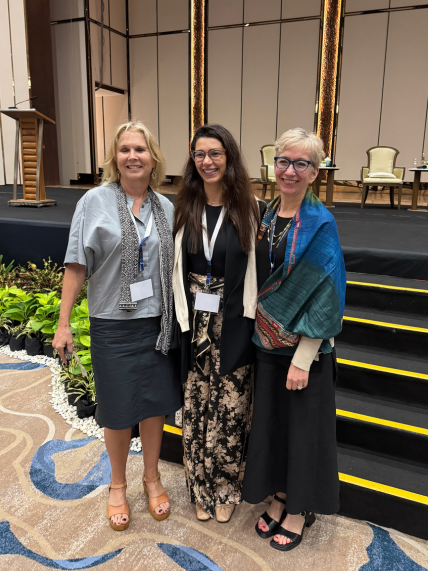
The Adam Wagstaff Prize recognises the Congress’ best paper on healthcare financing or delivery in low- and middle-income countries (LMIC) by a researcher from an LMIC. Established in in memory of former IHEA President, Adam Wagstaff (2016-2017), the award reflect his lifelong commitment to promoting equity in healthcare and research.
Rym's innovative study addresses a critical question: do doctors themselves amplify health inequalities during clinical encounters? Using an audit experiment (considered the gold standard for detecting discrimination— undercover patients presented identical symptoms of acute bronchitis to primary care doctors across Tunis. The patients differed only in how they portrayed their socioeconomic status, through differences in speech patterns, demeanour, and appearance.
The findings paint a nuanced picture. Reassuringly, there was no evidence of direct clinical discrimination: doctors did not provide better diagnosis or treatment to middle-class patients. However, stark inequalities emerged within doctor-patient communication. Poor patients were less likely to receive explanations about their illness, reasons for prescriptions, or guidance on follow-up care. And these gaps were particularly pronounced in private clinics.
Rym's rigorous research provides crucial evidence for Tunisia's ongoing medical education reforms and offers valuable lessons for health systems worldwide. Congratulation to Rym on this well-deserved recognition.
This section was written by Professor Tim Powell-Jackson.
Organising sessions on HIV prevention interventions
At iHEA 2025, I had the privilege of leading a 90-minute organised session in Bali titled “HIV Prevention Through Behavioural Change.” For this session, I conceptualised and organised the session, inviting fellow presenters and a discussant. This included drafting a plan, which shared it with my co-presenters to finalise the format. iHEA imposes few requirements beyond timing and encouraging audience participation, so we had creative freedom to shape the session.
Our panel featured Dr Henry Cust (Sanford School of Public Policy, Duke University), Dr Aurelia Lepine (University College London), and Dr Paul Dourgnon (Institut de Recherche et Documentation en Économie de la Santé, Paris). Together, we presented studies applying behavioural-economics theories to understand populations at the highest risk of HIV and other sexually transmitted infections in both sub-Saharan Africa and high-income countries. The goal: to improve the design and targeting of prevention interventions.
On the day, all speakers arrived early, giving us a few minutes to connect in person – some for the first time. As organiser and moderator, I welcomed the audience, introduced the speakers and discussant, and outlined the session format. Attendance was strong (about 30 participants), and discussion was lively and incisive.
One observation that has stuck with me: the need for further post-conference engagement. Despite the rich conversations during the session, iHEA offers no formal way to continue dialogue after presentations. Perhaps this is an opportunity for organisers like me to take the initiative by reconvening presenters and participants to share key insights and action points long after the conference lights dim.
This section was written by Kenneth Katumba.
How climate change impacts maternal, newborn, and child health
At the Congress, we had the opportunity to present ongoing work from the High Horizons Consortium where we’re working with researchers from 10 other institutes across Europe and Africa. Our work looks at the urgent and growing burden that climate change places on maternal, newborn and child health and global health systems, especially in low- and middle-income countries.
HIGH Horizons members were involved in the iHEA session, “Climate Change and Health Outcomes: Economic Evidence,” moderated by Giulia Greco at LSHTM.
This session featured a range of thought-provoking presentations:
- Dr. Olimpia Lamberti (LSHTM) – The Economic Burden of Extreme Heat on Pregnant and Postnatal Women in Zimbabwe and South Africa[AP1]
- Dr. Ziyi Lin (LSHTM) – The Burden of Climate-Related Diseases in Children Under Five: Disability-Adjusted Life Years in Kenya and South Africa Across Climate Scenarios
- Dr. Huiqi Chen (LSHTM) – The Economic Burden of High Temperatures on Brazil’s Health Systems
- Glory Apantaku (University of British Columbia) – From Risk Perception to Resilience: How Health and Social Factors Shape Support for Climate Adaptation in Canada
One theme resonated across all presentations: climate change is no longer a distant threat; it’s already inside our homes, communities, and health systems. This message echoed powerfully in the words: “Climate change lives inside us.”
Another key insight was preliminary analysis revealing an average monthly economic burden attributable to heat exposure of USD50, equivalent to nearly 20% of monthly income. This burden was mainly driven by direct medical and non-medical costs. This reinforces the need for evidence-informed and feasible interventions such as early warning systems, community engagement, climate-resilient facility design and adaptive health policies that prioritise equity and preparedness.
All of these considerations are essential components of our work at High Horizons. As well as working on early-warning systems for pregnant women like the MotherHeat Alert app, the project is looking at adaptations to reduce indoor temperatures and ways to reduce carbon emissions from maternity care facilities.
This section was provided by the High Horizons team, adapted from their LinkedIn.
If you enjoyed this article and would like to build a career in global health, we offer a range of MSc programmes covering health and data, infectious and tropical diseases, population health, and public health and policy.
Available on campus or online, including flexible study that works around your work and home life, be part of a global community at the UK's no.1 public health university.