Exposing the relationship between menstruation, contraceptive use, and gender-based violence
11 December 2025 London School of Hygiene & Tropical Medicine London School of Hygiene & Tropical Medicine https://lshtm.ac.uk/themes/custom/lshtm/images/lshtm-logo-black.png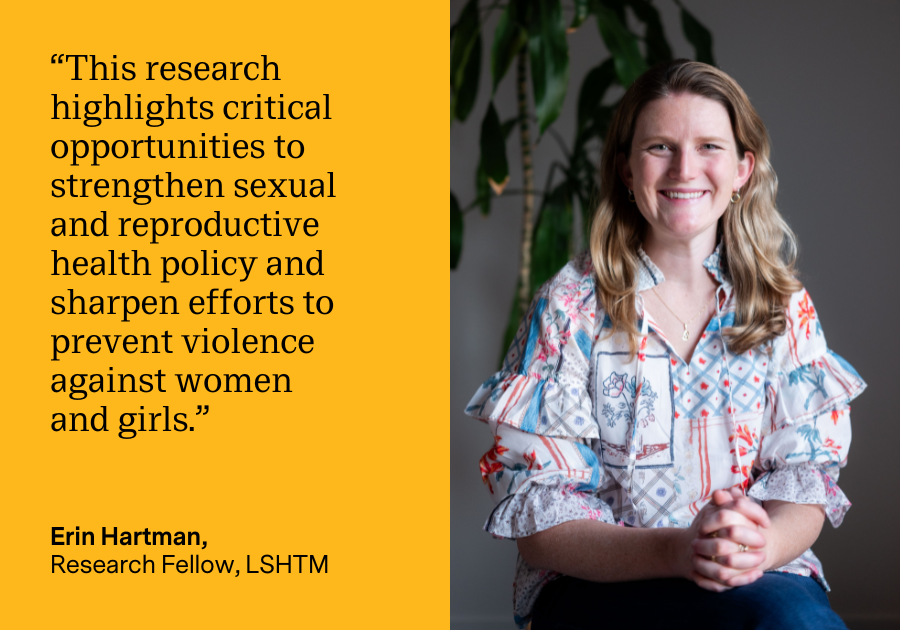
Trigger warning: This article contains information about intimate partner violence, gender-based violence and transactional sex which may be triggering.
Menstrual bleeding and contraceptive use were linked to experiences of intimate partner violence (IPV) and ultimately, found to compromise girls and young women’s freedom to make their own reproductive choices, according to a new study from research in Kenya published in BMJ Open.
In parallel, research also described transactional sex as a strategy to cope with period poverty and connected this to experiences of violence and poor health outcomes, such as unwanted and unintended pregnancy.
Transactional sex is sex that is exchanged for money, goods, or other benefits, often in non-marital, non-commercial relationships where the exchange is implicit rather than a direct, immediate payment like in traditional sex work.
The study, led by Erin Hartman in collaboration with Population Council Kenya, and supported by Hartman's supervisory team at the London School of Hygiene & Tropical Medicine (LSHTM) explored the complex relationship between menstruation, contraception use, and gender-based violence among girls and young women in Uasin Gishu County, Kenya.
The larger study for Hartman’s PhD explored girls and young women’s access to family planning services and use of contraceptive methods through interviews, focus group discussions, and a workshop with clinic clients, aged 15-19 years old, as well as clinic providers and health and education leaders.
Discussions revealed two common themes: IPV occurred in response to girls and young women’s menstruation and contraception use, and the stigma surrounding menstruation and girls and young women’s inability to afford sanitary pads led them to exchange sex for pads or for money to purchase sanitary products.
Intimate partner violence, menstruation and contraception
The study found that girls and young women visited family planning clinics or used contraception secretly because they feared there would be violent retaliation from their partners for trying to prevent pregnancy.
Yet study participants also described how their partners, and even sometimes their mothers, would track their periods, to try and detect if they might be using a contraceptive method or whether or not they were pregnant.
Some participants then reported that if their partner noticed that their period was regular (because they were not pregnant), the partner would react violently.
“[My friend’s] man kept wondering why she wasn’t conceiving. One day, he touched her [arm] and felt the implant. He waited until she was asleep, took a razor, and cut open her arm and removed the implant.” (Girl aged 15-17, IDI 19)
Participants also said their partners became violent if their menstrual bleeding patterns changed (which may happen as a side effect of contraception), because this signalled that they might be using contraception.
“[My clients tell me] if your periods become irregular, and you begin to bleed weekly or daily, your husband will ask you, ‘What’s not happening? Why are you bleeding? What has changed?’ So, you will have to tell him the truth [about using contraception], and that is when the violence begins.” (Community Health Worker, FGD 4, Provider 4)
The study also found that menstruation itself is a risk factor for IPV. This is because menstruation was perceived by partners to be a “sexual restriction” (Nurse Supervisor, FGD 3), due to harmful beliefs that menstrual blood is dirty, unclean, and something to be avoided.
“With this kind of ‘sexual restriction,’ because of the bleeding, the husband becomes angry at some point. ‘Every other time I want to do my things, I want to enjoy myself, this blood is bringing issues. Go and remove that method.’ So, they come [to the clinic] and remove the method because it is a hindrance to the husband’s sexual satisfaction.” (Nurse Supervisor, FGD 3)
Menstrual hygiene management and transactional sex for sanitary pads
The study also detailed the stigma attached to menstruation and its management – including that menstrual blood was seen as something to be ashamed of, especially if it visibly leaked on clothes – in addition to the challenges many girls and young women reported in being able to afford menstrual hygiene products, led girls and young women to engage in sex in return for sanitary pads or the money to purchase pads.
These – often exploitative exchanges – increased their risk of violence and contributed to adverse reproductive health outcomes, most commonly unwanted and unintended pregnancies.
“At that time when I had nothing, didn’t even have pads to use, and my periods are usually heavy and last over a week. I would ask him for the pads, and he would ask me to go to his house first [to have sex] so that he can buy me what I want. That is how I got pregnant. […] He accepted responsibility for the pregnancy and even visited the baby at my grandmother’s place where I was. The baby at that time was two months, but after that visit he completely disappeared to date. He has never even called me.” (Girl aged 15-17, IDI 14)
Family planning clinic providers revealed that many of these sex exchanges were unprotected. This was due in large part to the barriers to contraceptive access and use such as local laws and policies, stigma, fear and lack of knowledge. Many girls and young women were then left to navigate pregnancies alone, worsening their situation.
Stakeholders who took part in the study revealed insights into systemic issues in Kenya that could contribute to this behavior, including worsening financial hardship after the COVID-19 pandemic which prevented access to school-supplied sanitary pads, and a proposed Kenyan Finance Bill from 2024 that set out to add tax to imported sanitary pads and other essentials.
Implications of this study
Erin Hartman, Research Fellow at LSHTM and lead author of the paper, said: “From this research, it becomes unmistakable that menstrual bleeding – a universal and unavoidable part of life for women and girls – profoundly erodes sexual, reproductive, and bodily autonomy.
“Taken alongside the staggering global burden of intimate and non-partner sexual violence (affecting nearly one in three women and girls worldwide), the scale and urgency of these intersecting dynamics are impossible to ignore.
“I hope this research highlights critical opportunities to strengthen sexual and reproductive health policy and sharpen violence-prevention efforts. As a registered nurse and sexual assault forensic examiner, I see the relevance of these findings acutely; they matter not only for adolescent health and violence prevention in Kenya, but also here in the UK and in clinical settings like those where I practiced in New York City.”
Ana Maria Buller, Associate Professor at LSHTM and senior author on the paper, said: “We cannot reduce violence against girls while ignoring the structural realities that make them vulnerable. When menstrual stigma, economic hardship and contraceptive misinformation combine, they create conditions where coercion and violence flourish. Comprehensive prevention must address period poverty, challenge damaging norms about menstruation, and expand safe, stigma-free access to contraception.”
If you enjoyed this article and would like to build a career in global health, we offer a range of MSc programmes covering health and data, infectious and tropical diseases, population health, and public health and policy.
Available on campus or online, including flexible study that works around your work and home life, be part of a global community at the UK's no.1 public health university.