A decade apart, across contexts: two LSHTM alumni advancing menstrual health through systems and equity
28 May 2026 London School of Hygiene & Tropical Medicine London School of Hygiene & Tropical Medicine https://lshtm.ac.uk/themes/custom/lshtm/images/lshtm-logo-black.png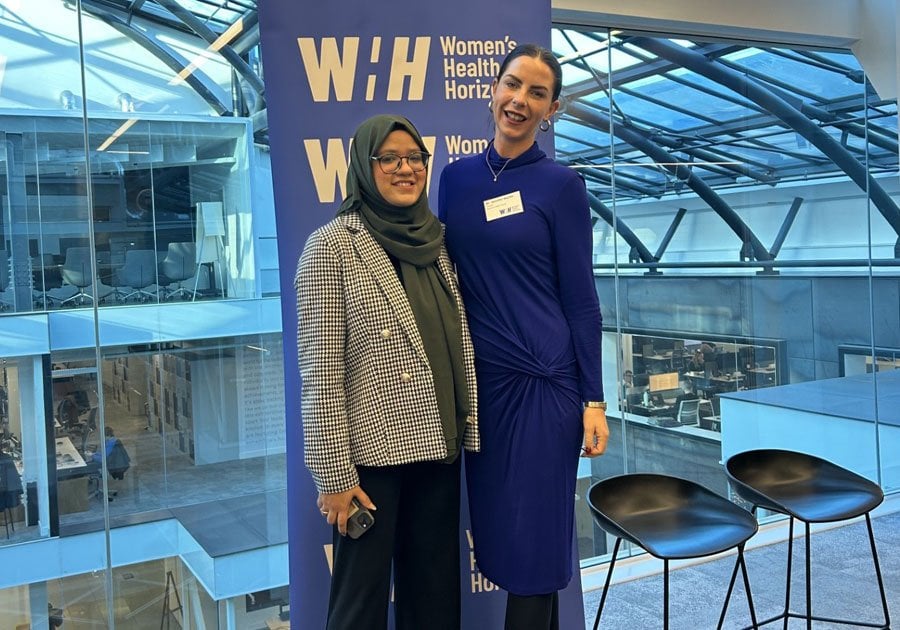
In 2014, while completing my MSc Control of Infectious Disease at the LSHTM, my supervisor, Val Curtis, suggested that I explore menstrual hygiene in Kenya. At the time, the issue was framed as something largely affecting low-income settings, shaped by infrastructure gaps and limited access to products.
I remember responding that we had many of the same issues in Scotland. That moment stayed with me, not because the contexts were identical, but because the framing felt incomplete. Menstrual health was being positioned as a problem of place, rather than something shaped by systems.
Over a decade later, working across different countries and contexts, we find ourselves returning to the same question: what is actually required to achieve menstrual dignity?
Sidra and I connected via LinkedIn and worked remotely on menstrual health and climate for nearly two years before finally meeting in London. Sidra had witnessed the impacts of period poverty firsthand during the 2022 floods in Pakistan, where displaced women and girls were resorting to dried leaves, sand and even cow dung to manage their menstruation. During her Health Policy, Process and Power module at LSHTM, Sidra also learnt about Chaupadi, a practice still observed in parts of Nepal and northern India in which menstruating women and girls are banished from their homes and required to sleep in isolated outdoor sheds or caves, based on beliefs that they are ritually impure. Despite being criminalised in Nepal in 2017, the practice persists and continues to expose women and girls to serious risks, including physical harm, sexual violence and death from cold exposure.
Based on our observations and global practices, our work across sexual and reproductive health and rights (SRHR), climate and community-based research has shown that menstrual health cannot be addressed in isolation. It sits across health systems, women’s leadership, education, infrastructure, social norms and policy, and is shaped by power, priorities and investment.
In 2020, Menstrual Rights Global was founded to respond to this gap. Since then, while contexts have varied, the underlying challenge has remained consistent.
We co-hosted a closed roundtable on the sidelines of the World Health Summit Regional Meeting with UNICEF, AMREF Health Africa, Pathfinder International and Irise East Africa on menstrual health, SRHR and social development in a changing climate. Despite the diversity of organisations and perspectives, the same message emerged.
There is no shortage of policies, strategies or global frameworks. What is missing is translation into programmes, meaningful monitoring, and sustained financing. This gap is difficult to justify when an estimated 1.8 billion women, girls and people menstruate every month [1], yet menstrual health continues to sit at the margins of global health and national agendas.
Part of the issue lies in how menstrual health is framed. It is often reduced to a WASH concern or a question of product access, which limits both analysis and response. This overlooks the wider implications for education, social and economic participation, mental health and bodily autonomy, despite growing evidence of these links [1,2].
It is also a political issue. Across global health and development spaces, gender equality and SRHR are increasingly contested, shaping what is prioritised, funded and implemented. Nearly a quarter of countries report backlash on gender equality as a barrier to achieving Sustainable Development Goal 5 [3].
Climate change is intensifying these dynamics. Climate-related shocks are already disrupting fragile infrastructure and access to essential services, with disproportionate impacts on women and girls due to existing inequalities [4,5]. These disruptions affect the ability to manage menstruation safely and access care, while increasing broader risks to health and wellbeing.
Despite this, menstrual health and SRHR remain largely absent from climate adaptation and humanitarian responses. This reflects a gap in prioritisation rather than a gap in evidence.
What remains clear is that this is not a knowledge problem. The frameworks exist, the evidence base is growing, and many of the most effective responses are already being led by grassroots and women-led organisations.
The challenge is one of systems, alignment and accountability. Until menstrual health is treated as integral to health systems, social policy and climate responses, rather than as an add-on, progress will remain limited.
Today, we continue to advance menstrual health within the context of climate by pushing the issue into spaces where it is often not prioritised or aligned. At the same time, we are committed to lifting each other up, and to supporting the wider community of practitioners and advocates working across this space. The relationships built through this work matter. They make it more grounded, more collaborative, and ultimately more meaningful. Although I am based in London and Sidra is in Islamabad, we continue to work together to move this agenda forward.
Returning to that conversation with Val more than a decade on, I am struck by how much it shaped the direction of this work. What began as an offhand observation became a lens through which to question the assumptions embedded in global health framing. It pushed me to look beyond geography and towards the systems, norms and power structures that determine whether people can manage their menstrual health with dignity, regardless of where they live. That question has not changed. If anything, the work of the past decade has only deepened it. I do wish that she had been here to see how she inspired a global movement!
References
- Rohatgi A, Dash S. Period poverty and mental health of menstruators during COVID-19 pandemic: lessons and implications for the future. Front Glob Womens Health. 2023;4:1128169. doi:10.3389/fgwh.2023.1128169
- Hennegan J, Winkler IT, Bobel C, Keiser D, Hampton J, Larsson G, et al. Menstrual health: a definition for policy, practice, and research. Sex Reprod Health Matters. 2021;29(1):1911618.
- UN Women. Progress on the Sustainable Development Goals: The gender snapshot 2023. New York: UN Women; 2023.
- Sorensen C, Murray V, Lemery J, Balbus J. Climate change and women’s health: impacts and policy directions. PLoS Med. 2018;15(7):e1002603.
- World Health Organization. Gender, climate change and health. Geneva: WHO; 2014.
For more information, you can contact: [email protected]