
There’s a vast amount of healthcare data in the world. And growing demand for medical statisticians who can analyse it to solve the biggest challenges in medicine.
Study the MSc Medical Statistics (or Biostatistics) to combine your passion for healthcare with your analytical mindset. Help to advance medical knowledge, prevent diseases, improve treatments, and influence government health policies. From designing clinical studies to identifying the causes of diseases, you’ll develop the specialist skills you need to play a vital role in global health and development.
What you will learn
- Learn to apply the theory and practice of statistics to clinical trials, epidemiology, and public health
- Answer medical questions and communicate your analysis to clinicians, scientists, patients and other statisticians
- Identify and explore your personal interests, ready to hit the ground running once you graduate.
How you will learn
We offer opportunities to learn from senior faculty in small, collaborative sessions. Each lecture you experience will be followed by a practical session – giving you the opportunity to immediately put theory into practice.
You will complete an independent data analysis project using real-world data and with individualized faculty support. This provides the experience you need to start your career in medical statistics.
And you’ll have access to our Centre for Data and Statistical Science for Health where speakers from around the world come to strengthen your knowledge in epidemiology and public health.
Who is it for?
Although many of our applicants have a mathematics-based first degree, you don't necessarily need a background in mathematics and statistics to succeed on this course. You don't need industry experience either. We just ask that you have a good working knowledge of calculus, algebra, probability theory and matrix algebra.
Many students get jobs offers long before they even finish their studies. You could work for academic institutions, the pharmaceutical industry, clinical trial units, and national health services.
Duration
One year full-time; part-time or split-study over two years. Ways to study explained.
Intercalating study
Are you an undergraduate medical student interested in developing your statistical skills? Learn more about intercalating this programme.
Medical Statistics
Previous Programme Director Kathy Baisley talks about the MSc in Medical Statistics.


Medical Statistics (or Biostatistics) is essential in both identifying the factors that cause disease, finding methods for epidemic prevention in future, and improving health services and public health.
Why study the MSc Medical Statistics at LSHTM?
- Small class sizes: Many classes are 25 students or less and led by LSHTM senior faculty
- Expert faculty: The course is affiliated with the Department of Medical Statistics, a leader in developing new methods for medical statistics and in applying medical statistics to applied projects, such as clinical trials and evaluations of public health interventions.
- Focus on contemporary methods and statistical rigour: The course is certified by the Royal Statistical Society and has been recently updated to incorporate new material on Bayesian analysis and modern epidemiological methods.
- Skills development: Students learn using a wide range of software packages, including Stata, R, and Stan.
- Employment opportunities: Among LSHTM alumni graduating between 2019 and 2023, 97% are currently working or in further study (source: analysis of Graduate Outcomes Survey). It is not uncommon for students to receive job offers before completing their studies.
Our alumni community
Our graduates work for academic institutions, the pharmaceutical industry, contract research organisations, clinical trial units, and national health services. For example, recent graduates now have positions at:
- GlaxoSmithKline
- Medical Research Council
- Numerus Ltd
- Oxford University
- Veramed
- Novartis
- London School of Hygiene & Tropical Medicine
Others have continued clinical training or are completing PhD programmes.
Why choose LSHTM?
- LSHTM is a specialist public health institution, renowned all over the world for its research excellence and prestigious postgraduate study programmes
- We consistently rank highly in various global university league tables, and have a strong academic and media presence worldwide
- The international character of LSHTM contributes significantly to the quality and range of its teaching and training: our students come from over 155 countries, with over 60% from outside the UK
- Our global graduate network of over 35,000 actively engaged alumni and international research collaborations create fantastic networking opportunities for students.


The MSc Medical Statistics can be taken 1 year full-time or 2 years part-time or split study. Courses are typically delivered with face-to-face lectures introducing new material, followed immediately by a hands-on practical session.
Full-time students are typically expected to be on campus 4 days per week, and part-time students 2 days per week. The below structure outlines the proposed modules for this programme.
Programme and module specifications provide full details about the aims and objectives of each module, what you will study and how the module is assessed.
- Structure of the year
Term 1 (September - December) consists of ten teaching weeks for AB1 slot modules, plus one Reading Week* in the middle of the term, followed by the Winter break.
Term 2 (January - March) consists of a further ten weeks of teaching for C and D slot modules, plus a Reading Week in the middle of the term. C modules are taught in five half-week blocks before Reading Week. D modules are taught in five half-week blocks after Reading Week, followed by the Spring break.
Term 3 (April - September) consists of five weeks of teaching for E slot modules, taught in half-week blocks, and the project report.
*Reading Week is a week during term where no formal teaching takes place. It is a time for private study, preparing for assessments or attending study/computer skills workshops. There are two Reading Weeks at LSHTM: one in November and the other in February.
- Term 1
All students take four compulsory AB1 modules:
- Concepts and Methods in Epidemiology
- Clinical Trials
- Foundations of Medical Statistics
- Introduction to Statistical Computing
- Terms 2 and 3
Students take a total of five study modules, one from each timetable slot (C1, C2, D1, D2, E). The list below shows recommended or compulsory modules. There are other optional modules which may be taken after consultation with the Programme Director.
C1 slot
- Statistical Models for Discrete Outcomes (compulsory)
C2 slot
- Survival Analysis (compulsory)
D1 slot
- Analysis of Hierarchical and Other Dependent Data
D2 slot
- Bayesian Analysis (compulsory)
E slot
- Advanced Statistical Methods in Epidemiology
- Causal Inference and Missing Data
- Project report
During the summer months (July - August), students complete a research project, for submission by early September. This usually consists of analysing a set of data and writing a report, but methodological research can also be undertaken.
Please note: Should it be the case that you are unable to travel overseas or access laboratories in order to complete your project, you will be able to complete an alternative desk-based project allowing you to obtain your qualification within the original time frame. Alternatively, you will be able to defer your project to the following year.
Prize
The Andrew Hewett Prize is founded in memory of Andrew Hewett, an alumnus of LSHTM, and awarded to the best student on the programme.
Changes to the programme
LSHTM will seek to deliver this programme in accordance with the description set out on this programme page. However, there may be situations in which it is desirable or necessary for LSHTM to make changes in course provision, either before or after registration. For further information, please see our page on changes to courses.
| Fees 2026/27 | ||
|---|---|---|
| Home | Full-time | £14,230 |
| Part-time | £7,115 | |
| EU/Overseas | Full-time | £31,450 |
| Part-time | £15,725 |
NIHR pre-doctoral fellowship
We support students interested in the NIHR pre-doctoral fellowship This fellowship supports a two year training programme, including MSc fees, additional post-MSC training, and two years’ stipend. Please contact the MSc Medical Statistics programme director at [email protected] for additional information.
Funding available for this programme:
Sources of funding:
In order to be admitted to an LSHTM master's degree programme, an applicant must:
- hold either a first degree at Second Class Honours (2:2) standard in a relevant discipline, or a degree in medicine recognised by the UK General Medical Council (GMC) for the purposes of practising medicine in the UK, or another degree of equivalent standard awarded by an overseas institution recognised by UK ENIC or the GMC.
or
- hold a professional qualification appropriate to the programme of study to be followed obtained by written examinations and judged by LSHTM to be equivalent to a Second Class Honours (2:2) degree or above.
or
- have relevant professional experience or training which is judged by LSHTM to be equivalent to a Second Class Honours (2:2) degree or above.
If you have not previously studied in the UK, you can check our guide to international equivalent qualifications for our master's degrees.
For the MSc Medical Statistics it is preferred that students should normally have obtained a mathematically-based first degree which includes some statistics. However, we accept students from a variety of backgrounds, so a mathematics or statistics-related degree is not necessary in order to be accepted on to the MSc. What is most important is a solid foundations in mathematics. In particular, we require a good working grasp of probability theory, calculus, basic algebra including logarithms and exponents, and familiarity with matrix algebra.
As part of the admissions process all suitable applicants will be invited to interview. Applicants who live overseas will be offered a video or telephone interview and those who live in the UK will be invited to LSHTM. We are also happy to interview UK applicants by video or telephone if preferred, due to work or study commitments.
We accept students from a variety of backgrounds, so a mathematics or statistics-related degree is not necessary in order to be accepted onto the MSc Medical Statistics. What is most important is a firm mathematical foundation. In particular, we require: a good working grasp of elementary calculus; familiarity with matrix algebra; and good working basic algebra, including logarithms and exponents. Some familiarity with elementary probability theory is also helpful.
Applicants who do not meet the minimum entry requirement, but who have relevant professional experience may still be eligible for admission. Qualifications and experience will be assessed from the application.
English language requirements
If English is not your first language, you will need to meet these requirements: Band B.
Some applicants may be exempt if they have previously studied in English or meet other specified criteria. Please see our English language requirements for details.
It is possible to apply without English language test results however the results of a test may be listed as a condition of an offer of admission.
Intercalating students
This option is available for in-person MSc programmes. You will need the equivalent of a bachelor's degree to undertake a master's degree. This will usually require you to have a BSc degree or have completed the first three years of your medical degree. More information on intercalating a Master's at LSHTM.
Access and widening participation
At LSHTM we are committed to ensuring that excellent students feel encouraged to apply for a course of study with us. We have introduced an innovative contextual admissions system that is designed to support those students who have faced the greatest barriers to their learning. More information on widening participation at LSHTM.
Applications for this programme are currently closed. Register your interest to be notified when applications open for 2026/27 (early November).
Applications should be made online and will only be considered once you have provided all required information and supporting documentation.
Please also read LSHTM's Admissions policies (pdf) prior to submitting your application.
You can apply for up to two master's programmes. Make sure to list them by order of preference as consideration will be given to your top choice first.
Please ensure you pay careful attention to the content of your personal statement as the clarity and relevance of the information you can provide is of considerable importance to us. We would like to know your experiences in the relevant field(s), your reasons for applying to our MSc, what you hope to gain from the training we offer, and how you intend to use the knowledge and skills you acquired to further your career and contribute to improving health. Please note that an interview may be required for this programme.
Application fee
A standard non-refundable application fee of £50 applies to all Master’s degree programmes and is payable upon application submission. The application fee also applies to PG Diplomas and PG Certificates where appropriate. Income generated from the application fee is shared between scholarships and the student hardship funds.
Application deadline
All applicants are encouraged to apply as early as possible to ensure availability of a place and a timely decision on their application. This is particularly important for applicants with sponsorship deadlines.
Closing dates for all taught face-to-face MSc, PG Diploma and PG Certificate applications for entry in the 2027/28 academic year is:
- Sunday 25 July 2027 at 23:59 UK time for all students requiring a Student visa
- Tuesday 31 August 2027 at 23:59 UK time for all UK, Irish and non-Student visa students.
Applicants will be required to meet the conditions of their offer and provide all necessary documents by the date of their Offer of Admission.
Tuition fee deposit
All applicants must respond to their offer of admission within 28 days or their place will be released and the offer automatically declined. The deposit is deductible from tuition fees upon full registration with LSHTM. Applicants in receipt of a full scholarship will not be required to pay the deposit.
- Home students: £500 non-refundable deposit, payable within 28 days of the offer date
- Overseas students: £2,000 non-refundable deposit
- Offers made before 31 January 2027: deposit due by 1 March 2027
- Offers made from 1 February 2027 onwards: deposit due within 28 days of the offer date.
Do you need a visa?
Please visit our Visa & Immigration pages for advice and guidance.
Important notice for nationals/citizens of Afghanistan, Cameroon, Myanmar or Sudan: If you require a UK student visa, the government has introduced a “visa brake”. As a result, LSHTM is currently unable to sponsor student visas for applicants from these countries.
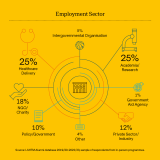
Graduates from this programme enter a diverse range of positions in public health, research, NGOs, health programmes, health services, government, policy and planning.
Employability
On average, 90% of our master's graduates from the 2019/20-2022/23 cohorts were in employment or undertaking further studies 15 months after graduation (Graduate Outcomes Surveys, 2020-2023).
Hear from a MSc Medical Statistics student
Lori describes her experience of studying the MSc Medical Statistics at LSHTM.
There is a shortage of well-trained medical statisticians and graduates from this course are in high demand. Graduates typically pursue careers in medical and epidemiological research, the pharmaceutical industry and various governmental institutions.
Below you will find just a few of the positions and organisations that our graduates from this course have entered after graduating:
- Example job titles:
-
Biostatistician
Clinical Programmer
Consultant
Fellow in Medical Statistics
Marketing Analyst
Medical Doctor
Medical Statistician
Post-Doctoral Researcher
Public Health Consultant
Quantitative Epidemiologist
Research Fellow
Data Manager - Example organisations:
-
Amnesty International
Cancer Research UK
Clinical Trials Research Unit (CTRU)
GlaxoSmithKline
London School of Hygiene & Tropical Medicine
Medical Research Council
Ministry of Health
MRC Biostatistics Unit
National Collaborating Centre for Women's & Children's Health
Numerus Ltd
Veramed
Infectious Diseases Institute
Novartis
LSHTM Alumni
LSHTM’s alumni community includes over 35,000 graduates across more than 190 countries. It offers a lifelong connection to LSHTM and to each other.
We are proud of our global alumni network, which includes many notable members, such as:
- Tedros Adhanom, the Director-General of the World Health Organization (WHO), who completed his MSc in Immunology of Infectious Diseases
- Karina Rando, the Minister of Public Health in Uruguay, studied MSc Public Health – Health Economics stream
- Christopher Whitty, Chief Medical Officer for England and Chief Medical Adviser to UK Government, studied MSc Epidemiology.
- Vanessa Bradford Kerry, founder of the non-profit Seed Global Health, director of the Program in Global Public Policy and Social Change at Harvard Medical School, and Special Envoy for Climate Change and Health for the World Health Organization (WHO), studied the MSc in Health Policy, Planning and Financing

- Career support - the LSHTM Careers Service provide a range of services from 1-1 appointments to events and workshops.
- Alumni blogs - did you know LSHTM has over 35,500 alumni in more than 190 countries.
- International alumni chapters - find an LSHTM network of alumni near you from our over 30 chapters.