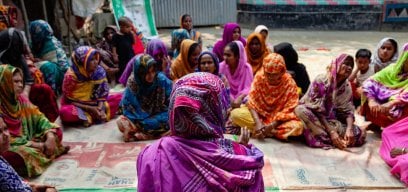
It is vital for global health efforts in sexual and reproductive health and rights to be expanded. This includes building more capacity in this field. From contraception to gender rights, and many other related topics, join us to learn more about the emerging and neglected issues across the area of sexual and reproductive health policy and programming.
Developed and delivered by LSHTM and the University of Ghana School of Public Health (UGSPH), this is an intensive online programme that can be taken full-time over one year. You will be taught by a team of academic staff and experts who have experience in developing policy and contributing to global health programmes. Your focus will be on developing skills to build programmes and influence policies that make a difference to the sexual and reproductive health of populations. Equipped with advanced knowledge of social-political, cultural, legal, and ethical issues surrounding sexual and reproductive health, you’ll finish the course ready to bring change and shape policies and practice.
What you will learn
- Explore policy and health system factors influencing sexual and reproductive health and rights (SRHR) in low and middle-income settings
- Investigate the influence of socio-political, cultural, legal, and ethical issues surrounding SRHR
- Study up-to-date evidence on effective SRH policies and interventions
- Design and cost SRHR programmes informed by the latest evidence and tailored to the context, including selecting appropriate methods to monitor and evaluate them
- Apply skills in communication with specialist and non-specialist audiences, advocacy, and collaborative working to engage effectively with stakeholders who influence SRH policy and programming
Modules cover topics including menstrual health, STIs and HIV, gender and sexual rights, safe abortion, adolescent SRHR, contraception and health systems. You will also learn skills such as programme monitoring and implementation research, designing and appraising evidence-based policies and programmes, and advocacy approaches for SRHR.
You’ll be taught through a mix of interactive activities such as live online lectures, group discussions and seminars, as well as pre-recorded lectures and independent study activities.
You’ll receive support from your tutor, as well as having the opportunity to join our unique mentorship programme and masterclasses delivered by experts in the field. Our masterclasses cover topics such as advocacy and case building for SRH, and career advancement in SRH. The mentorship programme pairs you with an expert in SRH, matching you based on common interests in the field. Your mentor will guide you in terms of leadership development, skills for success, and much more.
Who is it for?
We’ve designed this course for those interested in learning to design, implement, evaluate, and advocate for evidence-based sexual and reproductive health programmes and policies.
Perhaps you’re already working as a midwife, doctor, programme officer, or another role in SRH. You could also be intercalating study during your medical training or have a bachelor's degree in social science. You would have some previous experience in either low- and middle-income countries or in the SRH field.
Whatever your background, you’ll be the perfect fit for this course if you’re motivated to improve how SRH care is delivered and can demonstrate how studying the course will fit into your career growth path.
Graduates particularly work for NGOs or ministries of health, influencing policy and programmes.
Mode of delivery
The programme will be delivered wholly online, with no in-person attendance. There will be a mix of live and interactive activities (synchronous learning) as well as recorded or self-directed study (asynchronous learning). Examples of synchronous learning are live online lectures, group discussions and seminars. Asynchronous learning includes pre-recorded lectures, independent reading and activities.
Duration
The programme is 12 months full-time or 24 months part-time.
Full-time (12 months): Full-time students are expected to study approximately 40 hours per week including about 6-12 hours of synchronous learning per week (2-3 hours each day) during the teaching term. Live synchronous lectures and class sessions usually take place Monday-Friday between 2 pm and 5 pm UTC. Students are also required to attend all live sessions, and group work and undertake self-led study each week.
Part-time (24 months): Students can study part-time by studying for two or three days per week during the teaching term, and spreading all the modules required to complete a master’s programme over two years. There are no evening or weekend classes. Depending on module selection, students may be required to attend for different days in each term. Part-time students are expected to study approximately 20 hours per week including about 3-6 hours of synchronous learning per week (2-3 hours each study day) during the teaching term.
Postgraduate Certificate and Postgraduate Diploma
This programme also offers students the opportunity to register for a Postgraduate Certificate (PGCert) or Postgraduate Diploma (PGDip). Details of what each course entails are summarised in the Structure tab.
Sexual & Reproductive Health Policy and Programming
Watch Programme Directors Germaine Tuyisenge and Deda Ogum Alangea talk about the programme.

Fatoumatta Singhateh
MSc Sexual & Reproductive Health Policy and Programming

Sara Mengistu
MSc Sexual & Reproductive Health Policy and Programming
The below structure outlines the proposed modules for this programme. Programme and module specifications provide full details about the aims and objectives of each module, what you will study and how the module is assessed.
- View programme specification
- View intensive module specifications
- View distance learning module specifications
- Structure of the year
Term 1 (September - December) consists of ten teaching weeks for AB1 slot modules, plus one Reading Week* in the middle of the term. Followed by the Winter break.
Term 2 (January - March) consists of a further ten weeks of teaching for C and D slot modules, plus a Reading Week in the middle of the term. C modules are taught in five half-week blocks before Reading Week. D modules are taught in five half-week blocks after Reading Week. Followed by the Spring break.
Term 3 (April - September) consists of revision time, examinations (for students taking modules with June examinations) and the project report.
*Reading Week is a week during term where no formal teaching takes place. It is a time for private study, preparing for assessments or attending study/computer skills workshops. There are two Reading Weeks at LSHTM: one in November and the other in February.
- Term 1
Term 1: Compulsory modules (PGCert, PGDip and MSc)
Students take the following compulsory AB1 modules:
- Sexual and Reproductive Health and Rights
- Understanding and Applying Research Evidence
- Health Policy and Systems for Sexual and Reproductive Health
- PHM103 Introduction to Health Economics (by distance learning) or PHM107 Foundations for Health Promotion (by distance learning) or PHM108 Health Services (by distance learning) *
*Students choose one of the three modules. PHM103 and PHM108 are assessed by a written exam in June. PHM107 is assessed by assignment only; submission deadline 31st May.
- Term 2
Term 2: Compulsory and elective modules (PGDip and MSc)
Students take a total of four study modules, one from each timetable slot (C1, C2, D1, D2). The list below shows recommended or compulsory modules.
C1 slot
- Gender and Reproductive Rights
C2 slot
- Abortion Policy and Programming
- Family Planning Programmes (hybrid)
D1 slot
- Current Issues in Maternal and Perinatal Health (hybrid)
- Control of Sexually Transmitted Infections (hybrid)
- Programme Monitoring and Implementation Research
D2 slot
- Sexual and Reproductive Health Policy & Programming (compulsory)
Distance Learning modules: Students may also select from the following Distance Learning modules to study in C/D slots, to be taken instead of the options in C1, C2 and D1 above.
- Conflict and Health
- Economic Analysis for Health Policy
- Economic Evaluation
- Evaluation of Public Health Interventions
- Globalisation and Health
- Health Care Evaluation
- Health Systems
- HIV
- Law and Global Health Policy
- Managing Health Services
- Organisational Management
- Principles and Practice of Health Promotion
- Research Design and Methods for the Analysis of Global Health Policy
- Term 3
Term 3: Project report (MSc)
Students complete a written report (May-August) which may be undertaken as part of a placement, to apply the skills and knowledge acquired during the programme, exploring an area of SRHR in depth. The report may also take the form of an intervention design and piloting, for example, or a policy or programme evaluation. Not all placements in a sexual and reproductive health-focused organisation may lead to the identification of a suitable problem for a summer project, therefore students may also opt for a more traditional type of summer project (i.e. a systematic review, data analysis) depending on their skills and choice of modules.
Postgraduate Certificate and Postgraduate Diploma
This programme also offers students the opportunity to register for a Postgraduate Certificate (PGCert) or Postgraduate Diploma (PGDip). Details of what each course entails are summarised in the table below.
If you study the PGCert, most of your study and assessments will be concentrated in the Autumn Term (October-December) with some assessments in May or June. If you study the PGDip you will additionally take modules in the Spring Term (January-March). Further details on compulsory and elective modules and when they run are available above.
| Course | You study |
|---|---|
| Master's | 8 modules (5 compulsory, 3 elective) + project report |
| Postgraduate Diploma | 8 modules (5 compulsory, 3 elective) |
| Postgraduate Certificate | 4 modules (all compulsory) |



| Item | Full fee | Low- and middle-income countries |
|---|---|---|
| Master's | £23,100 | £17,850 |
| Postgraduate Diploma | £16,170 | £12,530 |
| Postgraduate Certificate | £9,240 | £7,160 |
| Fee to transfer registration to a higher award | £500 | |
*Mobile users, scroll right to view fees
Funding available for this programme:
Sources of funding:

Academic requirements
In order to be admitted to the MSc Sexual & Reproductive Health Policy and Programming, an applicant must:
- hold either a first degree at the UK equivalent to Second Class Honours (2:2) standard or above in a relevant discipline, or a degree in medicine recognised by the UK General Medical Council (GMC) for the purposes of practising medicine in the UK, or another degree of equivalent standard awarded by an overseas institution recognised by UK ENIC or the GMC.
or
- hold a professional qualification appropriate to the programme of study to be followed obtained by written examinations and judged by LSHTM and UGSPH to be equivalent to a Second Class Honours (2:2) degree or above.
or
- have relevant professional experience or training which is judged by LSHTM and UGSPH to be equivalent to a Second Class Honours (2:2) degree or above.
If you have not previously studied in the UK, you can check our guide to international equivalent qualifications for our master's degrees.
Additional requirements
Successful applicants for the MSc Sexual & Reproductive Health Policy and Programming are expected to have worked either in the health sector or the sexual and reproductive health field for a minimum of one year.
Applicants who do not meet the minimum entry requirement, but who have relevant professional experience may still be eligible for admission. Qualifications and experience will be assessed from the application.
English requirements
Please see our English Language Requirements and English Language Requirements Policy for more information.
You must meet one of the following:
- Be a national of a UKVI approved country list
- Have successfully completed a qualification (equivalent to a UK Bachelor's degree or higher), which was taught from the UKVI approved country list
- Have in the last ten years, successfully completed a degree-level course comparable to a UK Bachelor’s Degree at a UK ENIC recognised institution where the medium of instruction and assessment throughout the course is in English
If do not meet any of the above criteria, you will need to take a recognised English language test and meet requirements for band C.
IT requirements
You must have regular access to a computer with a reliable internet connection to access learning materials and fully participate in live synchronous classes often using Zoom.
To get the most from your studies, your computer should have at least the following minimum specification:
- a web browser (the latest version of Firefox, Chrome or Safari). This must accept cookies and have JavaScript enabled
- sufficient bandwidth to live synchronous classes: 1.0 Mbps/600kbps (up/down). Ideally 2-4 Mbps.
If you do not currently have a computer and need some advice around what to look for, please see the Technical Requirements for Students FAQs.
We strongly recommend you to have a built-in or stand-alone webcam. We also recommend you to have headphones or earphones to ensure you have better quality audio and more privacy.
Please note that the MSc Sexual & Reproductive Health Policy and Programming Scholarships offer support for IT equipment and/or internet costs/and/or other learning costs.
Applications should be made online and will only be considered once you have provided all required information and supporting documentation.
Please also read LSHTM's Admissions policies (pdf) prior to submitting your application.
You can apply for up to two master's programmes. Make sure to list them by order of preference as consideration will be given to your top choice first.
Please ensure you pay careful attention to the content of your personal statement, as we do not invite applicants to interview for this programme, so the clarity and relevance of the information you can provide is of considerable importance to us. We would like to know your experiences in the relevant field(s), your reasons for applying to our programme, what you hope to gain from the training we offer, and how you intend to use the knowledge and skills you acquired to further your career and contribute to improving health.
Application fee
A standard non-refundable application fee of £50 applies to all taught Master’s degree programmes and is payable upon application submission. The application fee also applies to PG Diplomas and PG Certificates where appropriate. Income generated from the application fee is shared between scholarships and the student hardship funds.
Application deadline
The final closing date for all taught online Master’s applications for entry in the 2026/27 academic year is:
- Monday 31 August 2026 at 23:59 UK time for all UK, Irish and non-Student visa students
Tuition fee deposit
Applicants are required to respond to their Offer of Admission and pay the £500 deposit within 28 days of receipt, or their place will be released and the offer automatically declined. The deposit is deductible from tuition fees upon full registration with LSHTM. Applicants in receipt of a full scholarship will not be required to pay the deposit.